Before a house goes up, a pole barn gets set, a pond gets dug, or a gravel drive gets installed, the land has to be ready. That means vegetation removed, grades established, drainage planned, and a stable, level surface created that the next phase of work can actually build on. Site preparation and land grading are the steps that turn raw or overgrown property into a usable, build-ready site — and doing them right determines how well everything that comes after holds up. Cornelius Forestry and Land Management handles site prep, land grading, and building pad construction for residential and rural properties throughout the Goshen, OH area and the surrounding region. Call (513) 403-6237 for a free on-site estimate.
What Site Prep and Land Grading Involve
Site preparation is an umbrella term for the work done to make a piece of land ready for construction, landscaping, or a specific end use. It typically includes clearing (removing trees, brush, and vegetation), rough grading (establishing general contour and elevation), fine grading (precise leveling to design grades), drainage planning (directing water away from structures and off the site), and building pad creation (a compacted, level surface at the correct elevation for a foundation, slab, pole barn, or shed). Land grading uses equipment — skid steers, track loaders, box blades, and compactors — to cut high areas, fill low areas, and shape the land to a specific grade. Getting the grade right is what determines drainage: a site that sheds water properly stays stable; one that doesn’t creates foundation problems, erosion, and ongoing maintenance headaches that can cost far more to fix than getting the grade right from the start.
Our Site Prep Process
Step 1 — Site Assessment and Planning
We visit the property and walk it with you to understand the project: what’s being built, what the finished elevations need to be, where drainage will go, and what existing vegetation or structures need to be cleared or worked around. For building pads, we need to know the foundation type (slab, crawl space, basement) and the builder’s grade requirements. For general grading, we assess existing drainage patterns and identify problem areas. Always call 811 before any grading work begins to have underground utilities marked.
Step 2 — Clearing and Debris Removal
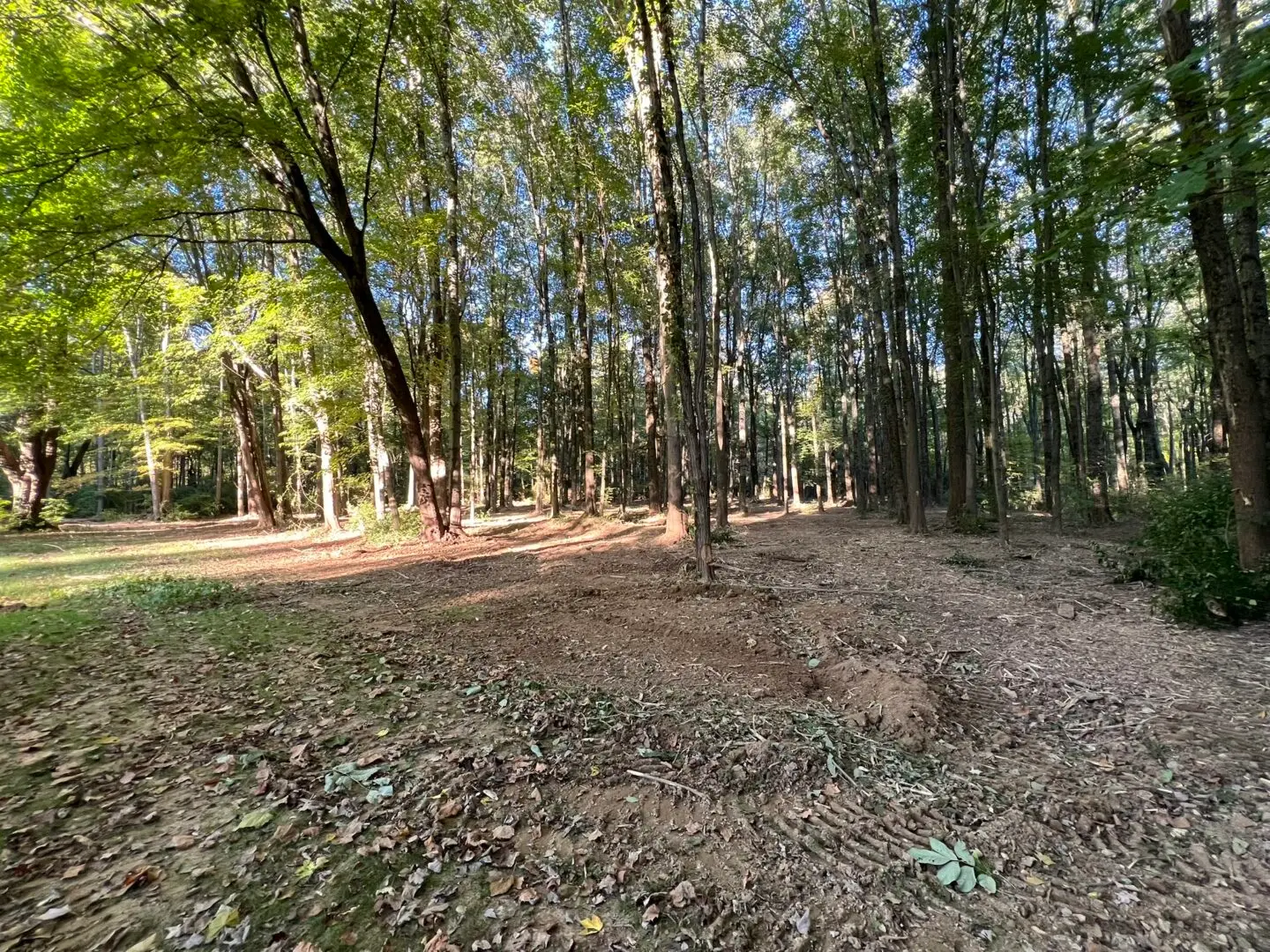
Site prep almost always starts with clearing — removing trees, brush, stumps, and organic material from the footprint of the project. Organic material left in a building pad area will decompose and create voids and settlement over time, so it has to come out before any grading begins. We handle clearing as part of the site prep sequence and can coordinate forestry mulching, stump grinding, and full land clearing as part of the same mobilization.
Step 3 — Rough Grading
Rough grading shapes the site to approximate final elevations using equipment to cut high spots and fill low areas. Cut material is used as fill where possible to minimize hauling costs. On sloped properties common to Clermont County’s rolling terrain, cut-and-fill grading redistributes earth from higher elevations to low areas to create the target grade without importing significant amounts of fill. Temporary erosion controls — silt fencing, straw wattles — are installed as needed to protect downslope areas during this phase.
Step 4 — Building Pad or Fine Grading
For building pad construction, the sub-grade is compacted in layers to the specified bearing capacity, and the pad surface is brought to final elevation and grade. For residential foundations in southwestern Ohio’s clay-heavy soils, proper compaction is critical — poorly compacted fill can shift and settle under load, creating structural problems years after the building goes up. Fine grading on the broader site establishes final contours for drainage, landscaping, and usability.
Step 5 — Drainage and Finish
Final site drainage is established — swales, berms, and positive drainage away from structures. On larger sites, storm drainage features may be needed; for most residential projects, proper grading alone directs runoff to acceptable discharge points. Projects over one acre that disturb soil may require an Ohio NPDES Construction Stormwater permit and erosion control plan — we can advise on requirements based on your project. The finished site is stable, at grade, and ready for the next trade.
Serving Goshen and Surrounding Southwest Ohio
CFLM handles site prep and grading projects throughout Clermont, Warren, Hamilton, Clinton, and Highland counties — Goshen, Milford, Batavia, Amelia, Loveland, Williamsburg, Bethel, Lebanon, Mason, Blanchester, Wilmington, and the rural and agricultural properties stretching across the region. Southwest Ohio’s clay-loam soils and rolling terrain require an operator who understands how to establish drainage on ground that holds water in wet weather and bakes hard in summer. For more about the range of property services we offer, see our home page.
Why Choose Cornelius Forestry and Land Management for Site Prep
Rob Cornelius’s background — son of a Caterpillar shop foreman, a lifetime around heavy equipment — translates directly to site prep work where operator judgment on compaction, drainage, and grade is what separates a pad that holds from one that settles. CFLM can sequence clearing, stump grinding, grading, and driveway work in a single project, which reduces mobilization costs and keeps your build schedule on track. Learn more about the family and operation on our About Us page. If your project starts with land clearing, see our Land Clearing page. If a gravel driveway is part of the project, see our Gravel Driveway page.