Property owners across Clermont and Warren counties deal with the same problem every spring: land that was manageable a few seasons ago has gone completely to brush, honeysuckle thickets, and invasive growth that chokes out everything worth keeping. Forestry mulching is the most efficient way to reclaim that land — a single machine grinds trees, brush, saplings, and undergrowth into a clean layer of organic mulch right where it stands, with no burning, no hauling, and no weeks-long cleanup afterward. At Cornelius Forestry and Land Management, we serve rural properties, farms, and wooded lots throughout the Goshen, OH area and the surrounding 60-mile region. Whether you’re opening a field near Milford, cleaning up a fence line in Batavia, or preparing acreage for a building project in Warren County, we’ll give you a straight quote and get the work done right. Call (513) 403-6237 for a free estimate.
What Forestry Mulching Actually Involves
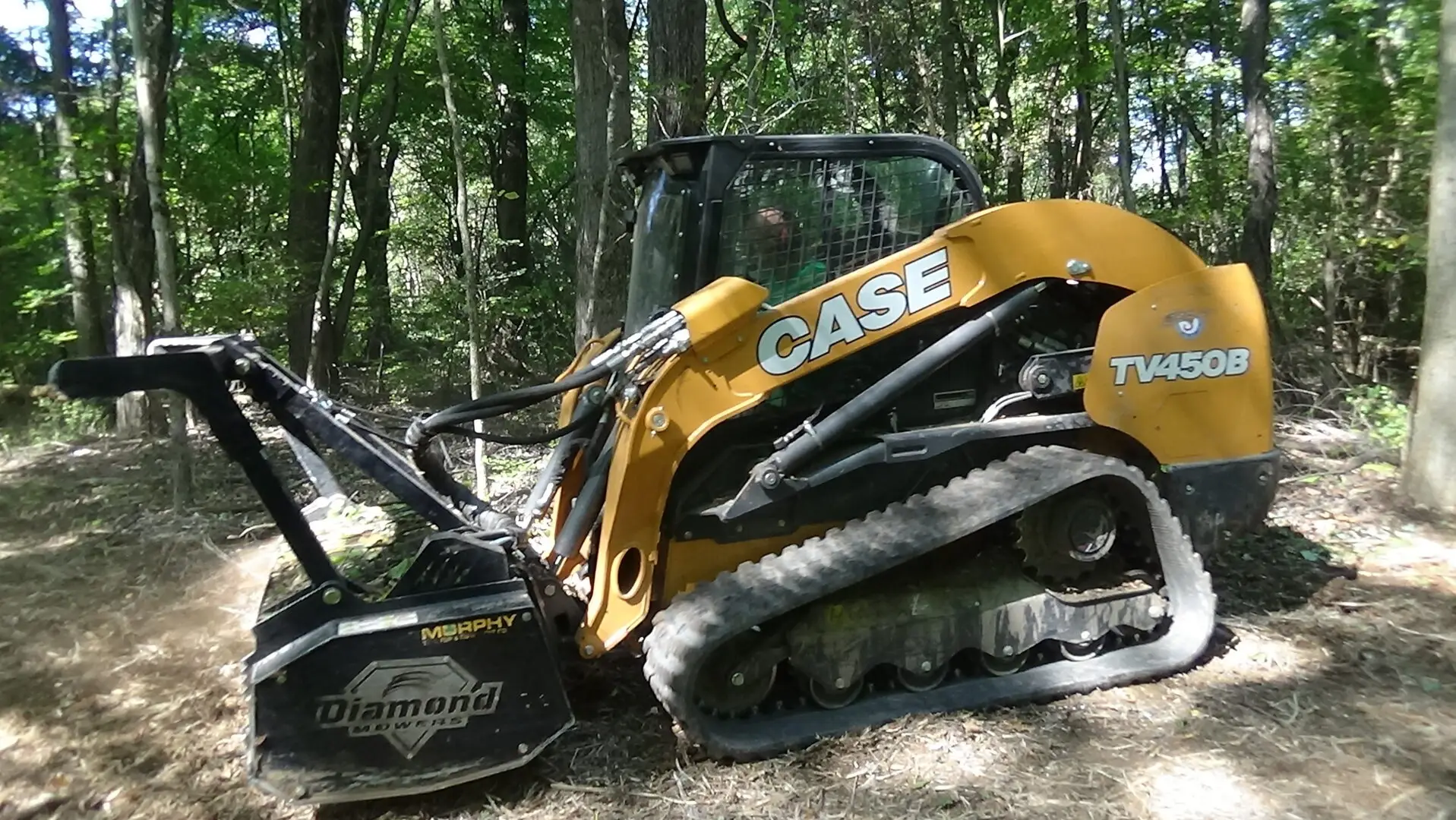
Forestry mulching is a land clearing method that uses one piece of equipment — a skid steer or compact track loader fitted with a hydraulic mulching head — to cut, grind, and process standing vegetation in a single pass. The mulching head spins a rotor drum packed with carbide-tipped steel teeth at high speed; as the machine advances, those teeth shred everything in front of them — overgrown brush, invasive shrubs, small trees, saplings, and vines — grinding the material into chips and fine organic matter that drop directly onto the ground surface. No separate chipper, no debris truck, no burn pile. The process starts with a site walkthrough to identify vegetation type, access points, and any trees you want to preserve, then the machine works the property systematically, section by section. On typical Clermont County properties — rolling terrain with mixed hardwood stands, dense honeysuckle, and multiflora rose along fence lines — the mulcher handles what would take days by hand in a fraction of the time. When the machine finishes, the land is flat, open, and covered in a natural organic layer that suppresses weed regrowth, retains soil moisture, and breaks down over time to improve soil health. You go from a wall of vegetation you can’t walk through to ground you can actually use.
Our Forestry Mulching Process
Step 1 — Free On-Site Estimate
We come out to your property in person — no guessing from satellite photos. Rob walks the site with you to assess vegetation density, terrain, access points, and any areas of concern like wet ground, buried debris, or trees you want to keep. Southwest Ohio’s rolling hills and creek-adjacent lowlands each change the scope of a job in ways that can’t be evaluated over the phone. You’ll leave the walkthrough with a clear, written quote and a realistic timeline so there are no surprises when the machine shows up.
Step 2 — Site Preparation and Access
Before the mulching head starts turning, we identify and mark any underground utilities (always call 811 before any ground-disturbing work), flag trees you want preserved, and plan the equipment path to minimize impact on soft or wet areas. Our track loader’s wide rubber tracks distribute weight across the ground, reducing compaction compared to wheeled equipment — an important consideration on the clay-loam soils common in the Goshen area and along creek corridors feeding into the East Fork of the Little Miami River.
Step 3 — Systematic Mulching
We work the property in overlapping passes, grinding everything from light brush to trees up to 8–12 inches in diameter. The carbide teeth on the drum handle invasive shrubs like bush honeysuckle and multiflora rose — which are among the most persistent vegetation problems in Clermont and Warren counties — with the same efficiency as native hardwood saplings. Heavy stands of mature brush may require a slower, more deliberate pass; lighter undergrowth clears quickly. Either way, all material is processed in place — there is no debris to haul out, and you won’t need a burn permit or a dumpster.
Step 4 — Final Pass and Site Review
After the main clearing is complete, we do a final pass to clean up any areas that need additional attention and ensure the mulch layer is consistent across the cleared surface. We walk the finished site with you to confirm the work meets what we quoted. The organic material left behind — typically 1–3 inches deep — acts as a natural ground cover that suppresses new weed seed germination, reduces erosion on slopes, and begins breaking down into the topsoil within one growing season.
Step 5 — What You’re Left With
When the trailer pulls out, your property is transformed. Fence lines are visible. Fields are open. Wooded lots that were impenetrable are now accessible. The mulch layer protects your soil while native groundcover establishes, and follow-up invasive species management is easier when the initial density is broken. Whether you’re preparing land for a new build, reclaiming overgrown pasture for livestock, or simply wanting your property back — this is what finished looks like.
Serving Goshen, OH and the Surrounding Region
Cornelius Forestry and Land Management provides forestry mulching throughout a 60-mile radius of Goshen, OH — covering Clermont, Warren, Hamilton, Clinton, and Highland counties and reaching into southwestern Ohio’s rural and agricultural communities. We regularly work properties in Milford, Batavia, Amelia, Williamsburg, Bethel, Loveland, New Richmond, Lebanon, Mason, Morrow, Owensville, Springboro, Blanchester, and Wilmington. We also serve the rural stretches along State Route 28 east toward Goshen, the creek corridors feeding into the East Fork of the Little Miami River south toward East Fork State Park, and the farm and woodlot properties tucked into Stonelick Township and beyond. If you own property in this region — whether it’s a residential lot that’s been sitting idle, a farm with fence rows buried in honeysuckle, or acreage you’re preparing for a future build — we’ll come to you. Learn more on our home page about the full scope of land management services we offer across the region.
Southwest Ohio’s terrain varies more than most people expect. The rolling hills of Clermont County drop into creek-cut ravines and bottom ground that can stay wet well into spring. The clay-loam and silt-loam soils common in the Goshen area pack hard in dry weather and turn soft under equipment pressure after rain. We work around those conditions — scheduling to avoid excessively wet periods and choosing equipment approaches that protect the ground you want to keep. For larger or more remote projects, Rob rents direct from Caterpillar and has equipment delivered to the job site, so mobilization distance isn’t a barrier to getting the work done right.
Why Goshen-Area Property Owners Choose Cornelius Forestry and Land Management
Rob Cornelius grew up around heavy equipment — his father was a Caterpillar shop foreman — and spent a lifetime developing an instinct for how machinery interacts with land. When he cleared his own property and discovered he loved the work, that passion turned into a business built on doing the job properly rather than just doing it fast. CFLM is a family-run operation: Rob’s son Gavin works alongside him in the field, and the family’s commitment to land stewardship — grounded in the belief that we’re caretakers of the ground we work — shows in how they approach every project. To learn more about the family behind the business, visit our About Us page.
Forestry mulching also eliminates one of the biggest headaches of traditional land clearing in Ohio: open burning. Under Ohio EPA regulations, burning land-clearing waste requires prior written notification — a process that can take weeks — and is subject to air quality restrictions, seasonal daytime bans from March through May and October through November, and setback requirements from neighboring properties. Forestry mulching sidesteps all of it: there’s nothing to burn, nothing to haul, and no permit to pull. The Ohio EPA open burning rules are specific about what’s allowed and when; for most property owners, grinding the vegetation on site is simply the cleaner, faster, and less complicated path.
CFLM operates across residential, agricultural, and rural commercial properties throughout southwestern Ohio. Whether your project is a quarter-acre wooded backyard or a 40-acre tract of overgrown farmland, we quote the whole job up front and don’t change the number when the work gets harder. For additional property services, see our related pages on Land Clearing and Bush Hogging and Gravel Driveway Maintenance.