Rural and residential properties throughout Clermont and Warren counties run on gravel driveways — long lanes serving farmhouses, access roads to back fields, private drives on acreage — and a gravel driveway that’s installed and maintained correctly lasts for decades with minimal intervention. One that’s installed wrong, or left unmaintained, turns into a pothole-ridden, washboard mess that washes out every spring and chews up vehicle suspensions. Gravel driveway installation starts with getting the base right — proper excavation, drainage, and compaction — so the finished surface holds up under daily traffic and Ohio’s freeze-thaw cycles. Cornelius Forestry and Land Management installs and maintains gravel driveways for residential and rural properties throughout the Goshen area and surrounding counties. Call (513) 403-6237 to schedule a free estimate.
What Gravel Driveway Installation Involves
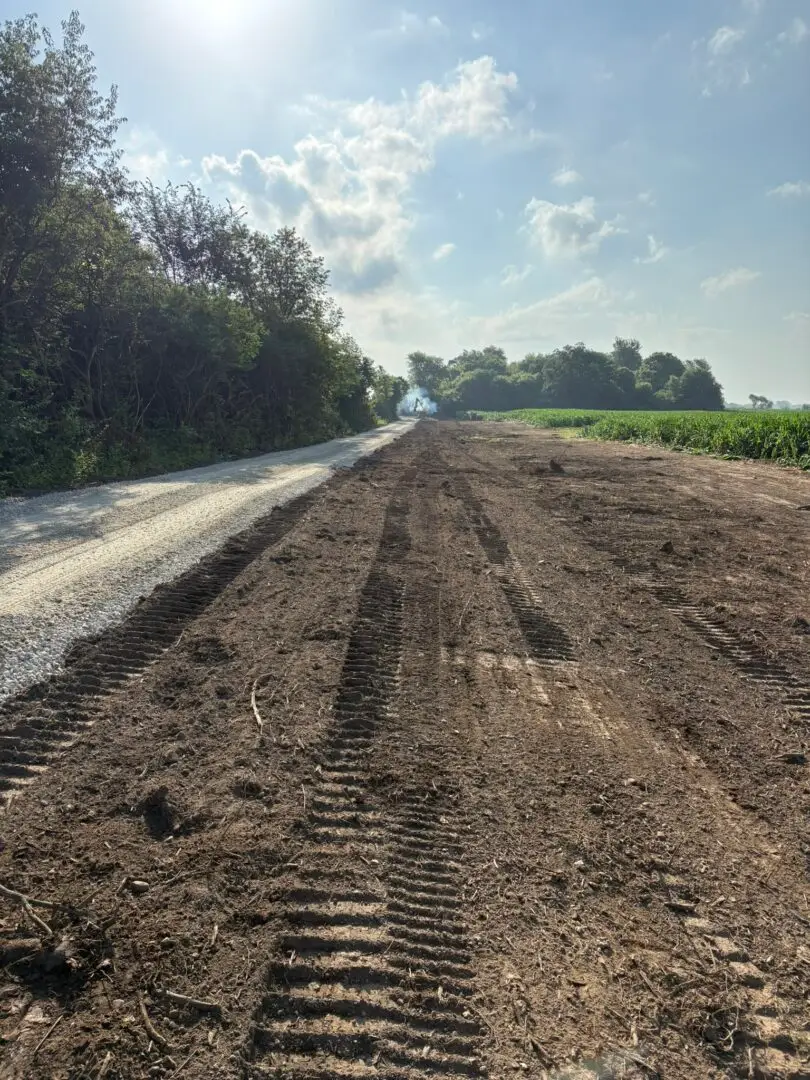
A properly installed gravel driveway is a layered system, not just stone dumped on the ground. The process begins with clearing and grubbing the driveway path — removing vegetation, roots, and organic material that would compress and sink under vehicle weight over time. The sub-base is excavated to the appropriate depth (typically 8–12 inches total for a residential driveway), and the native soil is graded to establish crown — a slight center-high profile that directs water off the driving surface rather than letting it pool and saturate the base. A compacted base layer of larger aggregate (#2 or #4 crushed limestone) provides structural support and drainage; the finished surface layer of #57 crushed limestone — angular 3/4-inch stone that interlocks and compacts without migrating — goes on top. On driveways with drainage problems, ditching along the sides and culvert installation at low points controls runoff before it can undercut the stone. The result is a surface that handles vehicle traffic, sheds water, and stays stable through Ohio’s wet springs and freeze-thaw winters.
Our Gravel Driveway Process
Step 1 — Site Evaluation and Layout
We walk the driveway path with you to assess current conditions: existing surface, drainage issues, vegetation to be removed, access width needs, and any areas with standing water or chronic wash-out problems. For new driveway installations, we identify the most practical route and confirm grades. For maintenance and repair work, we document the specific problem areas — potholes, rutting, washboarding, eroded edges — and discuss solutions.
Step 2 — Clearing and Subgrade Preparation
Vegetation along the driveway path is removed. The existing surface is either excavated to bare subgrade (for new installations) or scarified and re-shaped (for maintenance). Crown is established by shaping the center of the driving surface higher than the edges — even a 2-3% cross-slope effectively moves water off the road surface and into the ditches before it can saturate the base material. Always call 811 before any excavation work to mark underground utilities.
Step 3 — Base Course Installation
A base layer of compacted aggregate — typically #2 or #304 crushed limestone — is placed and compacted in lifts. This layer provides structural support and free-draining capacity under the finished surface. Culverts and cross-drain pipes are installed during this phase where drainage requires them. On long driveways crossing seasonal swales or drainage ways, undersized or clogged culverts are one of the most common causes of premature driveway failure.
Step 4 — Surface Course and Final Grading
The finished surface layer of #57 crushed limestone is spread, graded, and compacted. #57 stone is the standard choice for rural Ohio driveways: angular edges lock together under traffic, the 3/4-inch size provides a stable driving surface without the shifting of smaller stone, and the open structure provides good drainage. We crown the surface during final grading so the driveway sheds water properly rather than directing it into the base.
Step 5 — Ongoing Maintenance
Gravel driveways need periodic maintenance to stay in top shape — typically annual regrading to restore crown and fill low spots, pothole repair after hard winters, edge re-cutting to maintain proper drainage, and fresh stone added where traffic has displaced or compacted the surface layer. Catching small problems early (a minor low spot, a ditch that’s starting to silt in) costs far less than letting them develop into full washout repairs. We offer maintenance services across Clermont, Warren, and surrounding counties for existing gravel driveways.
Serving Goshen, OH and the Region
We install and maintain gravel driveways throughout the Goshen area and a 60-mile radius — Milford, Batavia, Amelia, Bethel, Williamsburg, Loveland, New Richmond, Lebanon, Morrow, Blanchester, Wilmington, and the rural properties across Clermont, Warren, and Clinton counties. Long farm lanes, private access roads on acreage, residential driveway extensions, and construction site access are all within our scope. See our full range of property services on our home page.
Why Property Owners Choose Cornelius Forestry and Land Management
Rob and Gavin Cornelius approach driveway work the same way they approach land clearing: quote the full job, do it right, and leave the property better than they found it. CFLM’s background in heavy equipment and land management means we understand how drainage, grades, and soil conditions interact — critical knowledge for a driveway installation that actually holds up. Learn more about us on our About Us page. If your project involves site clearing or grading before driveway installation, see our Site Prep page.