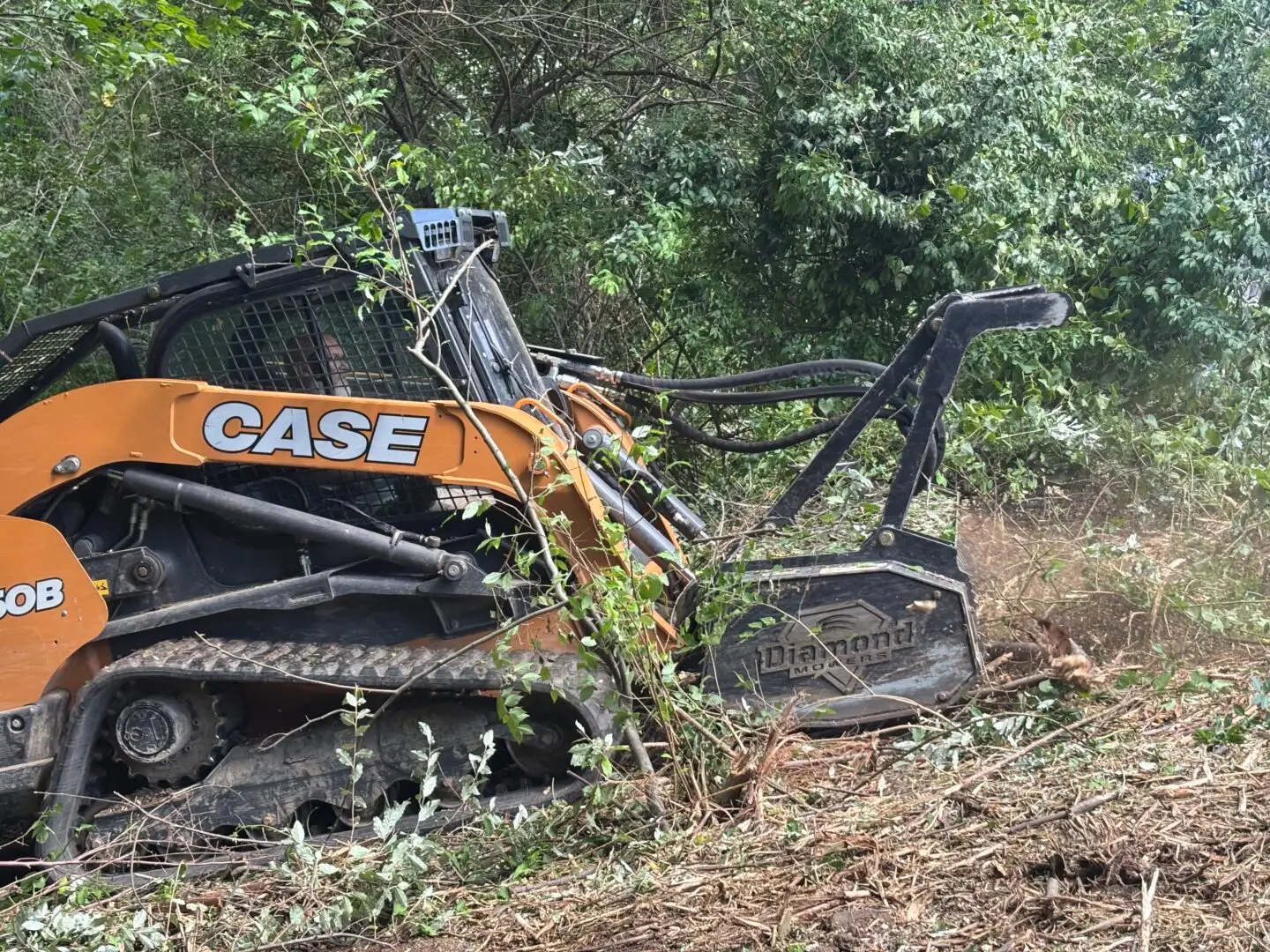
Fields, pastures, and fence lines have a way of getting away from you. A few seasons without maintenance and what was open, manageable land becomes a tangle of tall grass, briars, woody stems, and saplings that a standard mower can’t touch. Bush hogging — also called brush hogging or rotary mowing — is the solution: a heavy-duty tractor-mounted rotary cutter that powers through dense, overgrown vegetation in a single pass, cutting down and shredding what a finish mower would choke on. Cornelius Forestry and Land Management provides bush hogging for residential properties, farms, and rural acreage throughout the Goshen, OH area and surrounding counties. Whether you need a one-time field reclamation or recurring seasonal maintenance, call (513) 403-6237 for a free estimate.
What Bush Hogging Actually Involves
A bush hog is a rotary cutter attached to a tractor’s three-point hitch and driven by the power take-off (PTO) shaft. Unlike a finish mower with sharp, rigidly fixed blades designed for a clean cut on lawn grass, a bush hog uses heavy, hinged blades mounted on a spinning deck — blades that are intentionally blunt so they smash and shred rather than slice. The hinged design is critical: when a blade hits a rock, hidden stump, or thick woody stem, it swings back on its hinge and then returns under centrifugal force rather than breaking or binding. This lets the machine work through the kind of rough, uneven, rock-strewn terrain common on rural Ohio properties without constantly damaging equipment. The rotary cutter handles tall grass, thick weed stems, briars, brush, and saplings up to a few inches in diameter — cutting everything down to a uniform stubble height and leaving the shredded material on the ground to decompose naturally. It’s the right tool for reclaiming overgrown pastures, maintaining hayfields between cuts, clearing fence lines, and cutting roadsides and property borders where more expensive equipment isn’t warranted.
Our Bush Hogging Process
Step 1 — Property Walkthrough and Assessment
We inspect the field or area before the cutter goes in. This means looking for hidden rocks, stumps, fence posts, debris piles, or wet areas that could damage equipment or create access problems. On overgrown properties in Clermont and Warren County, old fence lines, discarded equipment, and buried debris can be completely invisible under tall vegetation — a pre-cut walk saves equipment and keeps the job on schedule. We also confirm the target cutting height and any areas you want left untouched.
Step 2 — Equipment Setup and Access
We position the tractor and rotary cutter for the most efficient cut pattern — typically starting from the outside edge of the field and working inward in overlapping passes. For fence line clearing, we run parallel to the fence in passes that bring the cutter head close without catching posts or wire. On properties with irregular shapes, wet corners, or terrain obstacles, we plan the approach to keep the machine moving productively.
Step 3 — Rotary Cutting
The bush hog works systematically through the property, knocking down and shredding everything in its path. Overlapping passes ensure complete coverage without missed strips. Cutting speed depends on vegetation density and terrain — lighter, open fields move faster; heavy, thick growth or rough terrain slows the pace. Areas with soft or wet ground get careful attention — we avoid working saturated soil that would rut under tractor weight. Ohio’s clay-loam soils in the Goshen and Batavia areas can hold water well into spring, and a rutted field is harder to fix than it was to prevent.
Step 4 — Edge and Detail Work
After the main field pass, we address perimeter edges, corners, and any areas that needed a second pass due to density. Fence lines are cleared of encroaching brush and woody growth that causes fence damage and reduces visibility. Property borders are cut to a clean, defined edge. We don’t rush this step — a bush hogging job that leaves ragged edges and missed corners isn’t finished.
Step 5 — Site Review
We walk the finished area with you to confirm the work is complete and meets what we quoted. The cut material remains on the ground as a natural mulch layer that breaks down over time, returning organic matter to the soil. For pastures being reclaimed for livestock, we can discuss follow-up seeding, liming, or weed control strategies to get the field productive after the initial cut.
When Bush Hogging Is the Right Tool — and When It Isn’t
Bush hogging is the most cost-effective solution for clearing vegetation that’s too heavy for a finish mower but doesn’t warrant the larger investment of forestry mulching. It works well for tall grass, field weeds, light brush, and small saplings on relatively open land. It’s the workhorse of farm maintenance — keeping pastures grazable, hayfields manageable, and fence lines clear. However, bush hogging has limits: it can’t handle trees more than a few inches in diameter, it doesn’t process material the way a mulcher does (it cuts and drops rather than grinding), and it’s less effective on terrain that’s too steep or uneven for a tractor to work safely. For overgrown properties with dense brush, invasive species, and woody growth above the cutter’s capacity, forestry mulching is the better tool. We’ll tell you honestly which approach fits your property during the walkthrough.
Serving Goshen, OH and the Surrounding Region
CFLM provides bush hogging throughout a 60-mile radius of Goshen — covering rural and agricultural properties across Clermont, Warren, Hamilton, Clinton, and Highland counties. We regularly work farms, pastures, vacant lots, and overgrown acreage in Milford, Batavia, Amelia, Loveland, Williamsburg, Bethel, New Richmond, Lebanon, Morrow, Blanchester, Wilmington, and Springboro. The rolling farmland and creek-bottom fields across Clermont and Warren counties grow back fast — we help property owners stay ahead of it with one-time reclamation cuts and recurring seasonal maintenance. See all of our land management services on our home page.
Why Property Owners Choose Cornelius Forestry and Land Management
Bush hogging is practical work that comes down to the operator’s judgment and reliability. Rob Cornelius and his son Gavin bring both — CFLM is a family-run operation built on a lifetime around heavy equipment and a genuine commitment to the land. We show up when we say we will, quote the full job upfront, and don’t leave a property half-finished. Read more about us on our About Us page. If your property needs more than bush hogging can handle, see our pages on Forestry Mulching and Land Clearing.