Whether you’re preparing a rural lot for a new home, reclaiming overgrown farm acreage, or clearing a fence line that’s been buried in brush for years, the process starts the same way: you need the land cleared before anything else can happen. Land clearing is the foundation of nearly every outdoor project — and getting it done right, with the right equipment and an operator who knows the terrain, makes every phase of work that follows easier. Cornelius Forestry and Land Management serves residential property owners, farmers, and rural landowners throughout the Goshen, OH area, covering Clermont, Warren, Hamilton, and surrounding counties. Give us a call at (513) 403-6237 for a free estimate — we come to you.
What Land Clearing Involves
Land clearing is the process of removing trees, brush, stumps, undergrowth, and debris from a property to make it usable, accessible, or build-ready. The scope varies considerably depending on what’s on the land — a half-acre residential lot with scrubby growth is a fundamentally different job than 20 acres of wooded Clermont County hillside — and the right approach depends on what you’re doing with the land afterward. At CFLM, we handle the full scope: tree removal using chainsaws and mechanical equipment, brush and undergrowth clearing with a forestry mulcher or brush hog, stump grinding below grade, and debris management. For properties where burn-pile restrictions apply under Ohio EPA rules, we process material on site using the mulcher rather than creating piles that require permits and scheduling. The result is land that’s clear, accessible, and ready for whatever comes next — whether that’s a building pad, a pasture, a gravel driveway, or simply a yard you can walk through again.
Our Land Clearing Process
Step 1 — Site Walkthrough and Free Estimate
We come out to the property in person. Rob walks every parcel with the landowner to understand the scope: what’s coming out, what’s staying, where equipment will access, and what the end goal is. Properties along Clermont County’s creek drainages or near wetlands get extra attention for setback requirements. Always call 811 before any ground-disturbing work to have utilities marked.
Step 2 — Tree and Canopy Removal
Larger trees are felled using chainsaws and directional felling techniques, with cut timber limbed and bucked on site. On wooded properties, we work in a logical sequence — clearing canopy first so equipment can access the understory — rather than forcing machines through standing timber. For properties where selective clearing is the goal (keeping certain oaks or established shade trees while removing invasive species), we mark what’s staying before any cutting begins.
Step 3 — Brush, Undergrowth, and Debris Clearing
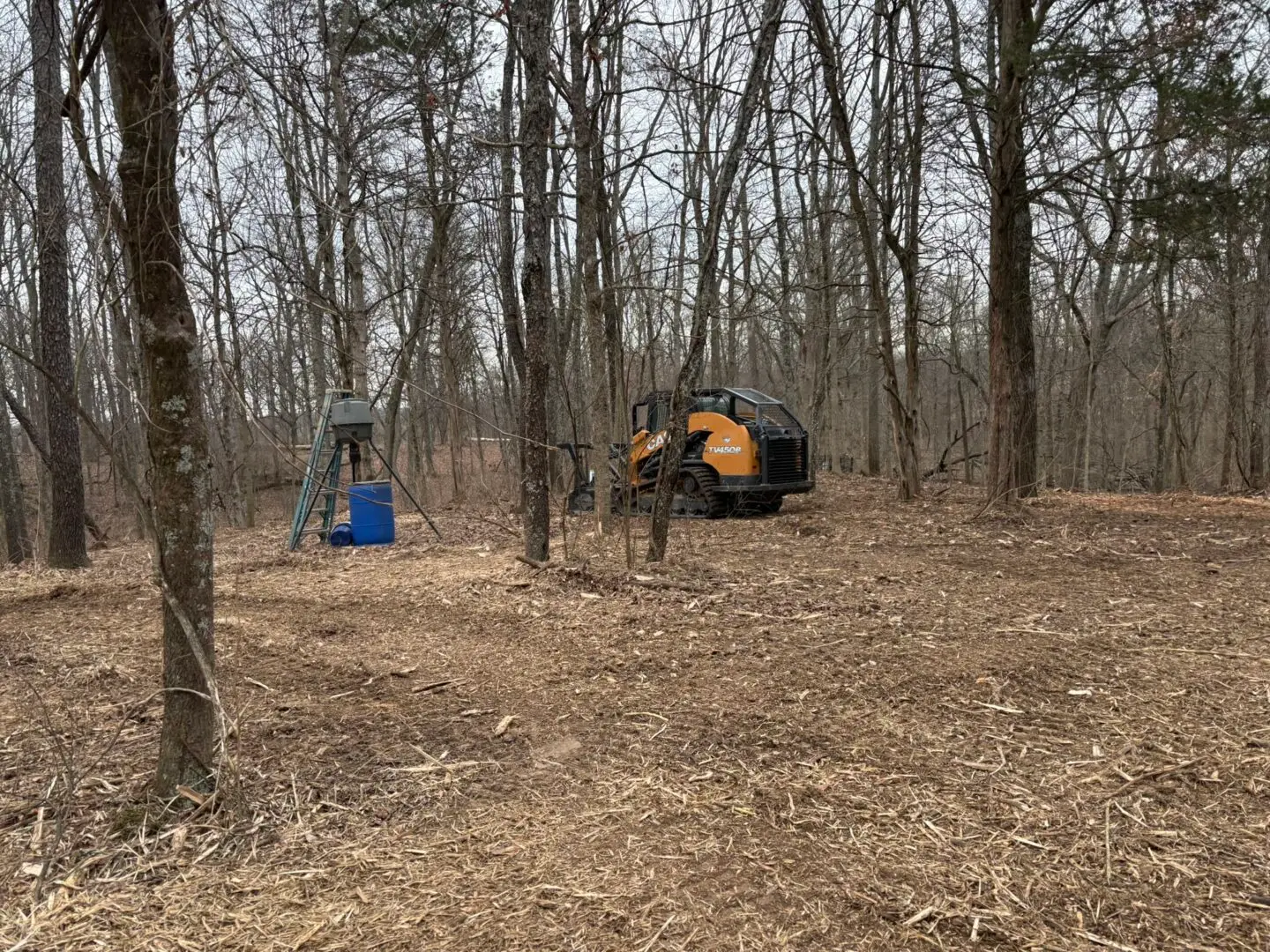
Once larger trees are down, a skid steer with a forestry mulching head or brush hog attachment handles the undergrowth, saplings, briar patches, and invasive growth — the bush honeysuckle, multiflora rose, and autumn olive that overtake so many Clermont and Warren County properties. All material is processed on site into a ground-cover mulch layer that breaks down naturally. No hauling, no burn pile, no debris to manage after we leave.
Step 4 — Stump Grinding
Stumps left from felled trees are ground below grade — typically 6–8 inches — using a dedicated stump grinder. Grinding depth depends on the end use: surface-level grinding handles areas that will be re-seeded or left natural; deeper grinding is needed for areas that will be graded, paved, or built on. Wood chip debris can be left as organic fill or removed depending on your plans for the space.
Step 5 — Final Grade and Site Review
We walk the cleared site with you to confirm the work is complete and the land is in the condition we quoted. On larger properties, a rough grading pass levels out ruts and uneven areas left by equipment work, leaving the ground workable and accessible. If the next step is a gravel driveway, building pad, or site prep project, we can sequence that work into the same mobilization to keep your project moving.
Serving Goshen, OH and the Surrounding Region
We clear land throughout a 60-mile radius of Goshen, covering rural and agricultural properties across Clermont, Warren, Hamilton, Clinton, and Highland counties. Regular work areas include Milford, Batavia, Loveland, Amelia, Williamsburg, Bethel, New Richmond, Lebanon, Mason, Morrow, Blanchester, Wilmington, and the unincorporated townships between them. A large share of our land clearing work happens on properties along the creek corridors and rolling terrain of eastern Clermont County — the kind of land that borders East Fork State Park and the Little Miami River system, where wooded draws and bottomland grow back fast if they’re not actively managed. Learn more about our full range of property services on our home page.
Southwest Ohio’s mix of clay-loam soils and seasonal wet conditions means land clearing scheduling matters. We avoid working saturated ground that will rut under equipment weight, and we plan access routes to minimize damage to areas you want to preserve. For projects more than 30–40 miles from Goshen, Rob rents and coordinates direct equipment delivery through Caterpillar so mobilization distance isn’t a barrier to getting the work done.
Why Property Owners Choose Cornelius Forestry and Land Management
Rob Cornelius grew up around heavy equipment and developed an operator’s instinct for how machines should move on different terrain. CFLM is a family-run operation — Rob’s son Gavin works on site — with a land stewardship philosophy grounded in doing the work right the first time. Read more about the team on our About Us page. We provide free on-site estimates, quote the full job before work begins, and don’t change the number when the ground is harder than expected. For related services, see our pages on Forestry Mulching and Stump Grinding.